Never Ask a Chatbot One Question
One question keeps you in automation. Conversation gets you to flow.


The design of screen activities which will enjoyably focus the user’s mind on his proper concerns—no matter how personal these may be—is the new frontier of design, of art, and of architecture. - Ted Nelson, 1974
Most of us spend most of our time doing the same things repeatedly. This is often machine work. Teachers grade the same assignments repeatedly. Professionals write contracts and put in orders repeatedly. None of these challenge us as humans.
This is mentally unhealthy. We are not robots. It’s also deadening. We have no incentive to learn. The only learning we do is how to get out of doing these tasks faster.
The Iterative Loop (The Science of Flow)
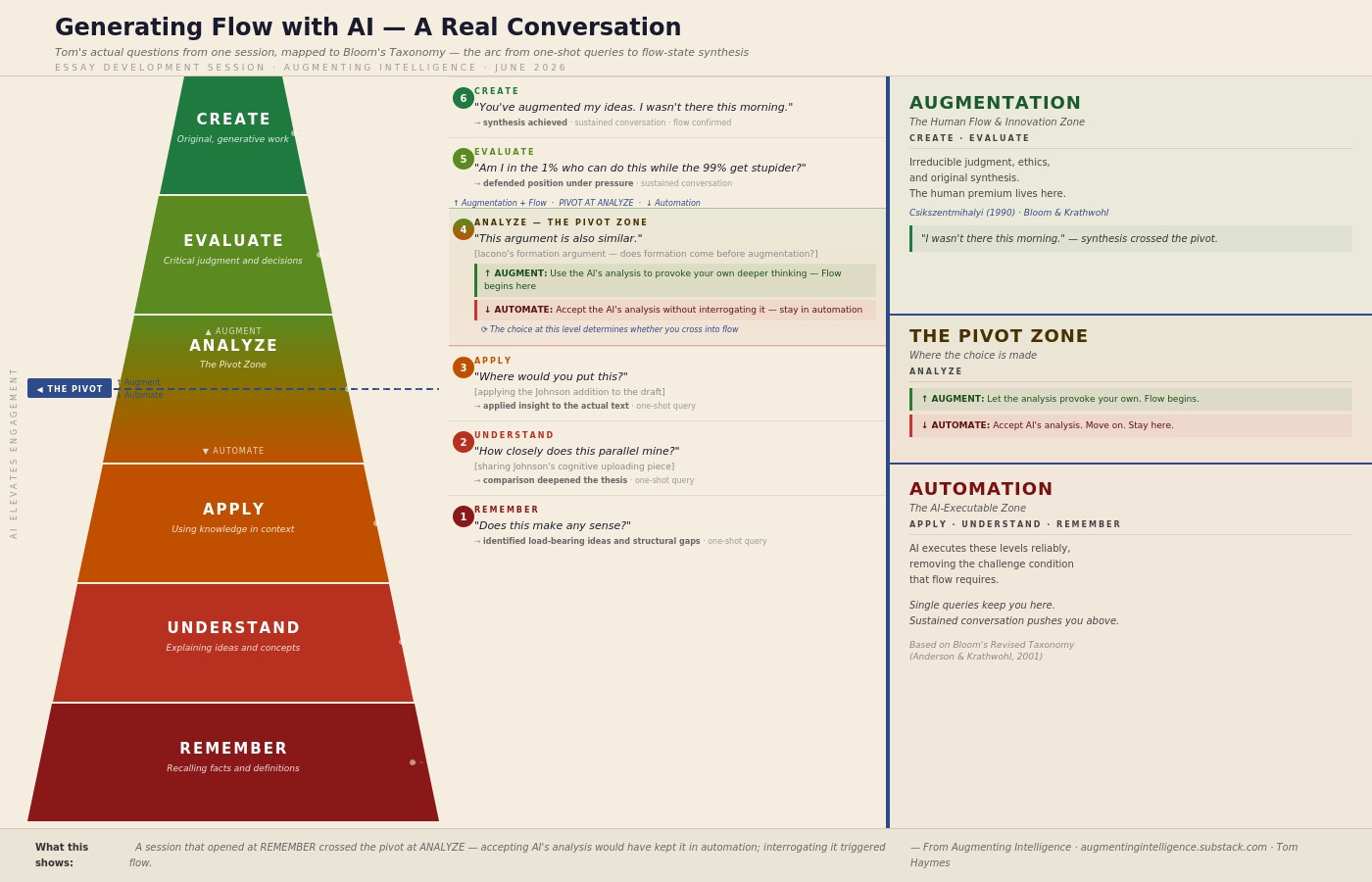
AI changes this. It pushes us upward on the Bloom’s pyramid if we use it properly. AI invites us to challenge ourselves mentally. Rapid repetition and iteration as we have conversations with our chatbots pushes us toward Mihalyi Csikszentmihályi’s Flow.
When I walk, I often enter a Flow state. It’s where ideas flow from my head because I’m free of distraction and the motion of my body liberates my brain. One turning point came several years back. When dictation became good enough, I started dictating entire blogs on my walks.
More recently, in addition to writing, I’ve been having conversations with Claude and Gemini on my walks. A problem comes up in my head, and I start to explore it. This involves a lot of give and take but this process speeds up the coalescing of my ideas around something I might be able to make understandable to the rest of the world.
I probe. I argue. The AI pushes back on my argument. I clarify it. I stop the AI from going down unproductive tracks. The next thing I know, I’ve walked a mile and have no memory of how I got there, just the flow of ideas.
This prompted a set of ideas itself. Does the chat drive me into a Flow state? Does it open my eyes to a pathway forward? I am writing these words in the aftermath of a walk where I explored some of these ideas with Claude. It’s got my head buzzing.
This is the holy grail of learning. You are learning invisibly while you are mounting mental challenge after challenge iteratively. I want the same thing to happen to others, particularly my students.
The Classroom Experiment
I’ve tried to design this into my teaching. This has led to a lot of flow-like conversations as I’ve tossed around ideas for how to structure my class for people who may have never experienced this before.
This morning, I did an in-class exercise demonstrating this to my students. One of the first hurdles they have to cross is digging down into underlying issues driving social challenges.
I used Gemini to interrogate a challenge until it gave a root problem. In this case it was standardized testing. The effort showed my students how many queries I had to put to the chatbot before I got where I needed to go.
Afterwards, they did the same thing themselves and posted their “root issues” to a discussion post. I asked them how many questions they asked. The answers ranged from 3 to 9. You could tell the difference in their posts. That was the real lesson.
This is not how it has always worked. In the past, my classes got bogged down in the lower levels of Bloom’s taxonomy because that was all my students could do. The tools were insufficient to do this quickly or efficiently. I was the only nexus point for feedback. This is where the Flow fell apart: waiting for me to get back to them.
Dylan Wiliam suggests that teachers, “use every opportunity to transfer executive control of the learning from the teacher to the students to support their development as autonomous learners.” This is exactly what giving them access to a chatbot and teaching them how to do iterative conversations with it does.
They control the conversation with themselves. I don’t. Flow is about having a conversation with yourself and is disrupted by interference from the outside world.
Furthermore, since I started working with AI and teaching my students how to do the same, I have been able to push them up to more challenging levels than I think even they think they can do.
Addressing the Foundations Argument
Recently, Carlo Iacono wrote that we are at risk of losing our foundations to AI because it does this low level work for us. As a result, we never get a chance to practice with them.
The essay is not only a container for an argument. It is one of the means by which the capacity to argue is built. The maths problem is not only a request for an answer. It is a machine for producing mathematical judgement… these are not obsolete rituals around the real work. They are the real work.
He’s not wrong. However, in my class now, this foundational learning goes on before I even have to intervene. That’s because I have an AI prompt they must clear before I will even look at it.
When I elicited feedback on this process, I found out that some of them iterate with the AI 8 or 9 times before they get an “all clear.” Working all of them up to that level of interaction is the real challenge.
I can focus my limited energy on their ability to evaluate and create. This does two things. First, I spend my effort helping them through the challenges of the higher levels of Bloom’s taxonomy.
Second, and more importantly, they find themselves challenged like they’ve rarely been challenged in a class before. Getting past the AI hurdle is like playing a game. This is more likely to push them into a Flow state.
Offloading Executive Control
Before Generative AI, this was hard to achieve because the steps were too big if I wanted to get them to the highest level. They either got frustrated or tried to make me do the mental work for them.
By making them take steps up the ladder too quickly, I was violating what Lev Vygotsky called the Zone of Proximal Development. He wrote:
But recently psychologists have shown that a person can imitate only that which is within her developmental level. For example, if a child is having difficulty with a problem in arithmetic and the teacher solves it on the blackboard, the child may grasp the solution in an instant. But if the teacher were to solve a problem in higher mathematics, the child would not be able to understand the solution no matter how many times she imitated it
The problem is that iterating this with them took too much time. At a certain point, I had to say, “you’re a college student. Figure it out.” Then I got frustrated when they didn’t.
My expectations got lower and lower as I spent all my time grading mechanics, not thinking. This robbed me of flow as much as it surely did them.
As a boss, I had the same problems. Routine tasks took over my department’s daily activities. My creative thinking focused on minimizing these for my employees.
It wasn’t about what we could do. It was managing what we had to do in the most efficient way possible. This was easily the most tiring part of my job.
If I had an AI chatbot then, I could have asked them to work on their problems before bringing them to me. This potentially puts them into their own Flow state instead of counting on mine to bail them out.
Csikszentmihályi argues that to achieve Flow you have to achieve a high level of focus. He writes in his book Flow:
When all a person’s relevant skills are needed to cope with the challenges of a situation, that person’s attention is completely absorbed by the activity. There is no excess psychic energy left over to process any information but what the activity offers.
It’s much harder to get into a Flow state at the higher levels. It’s impossible if all your psychic energy is spent wrestling with routine or foundational tasks. We might be able to achieve Flow doing those tasks but then all our psychic energy will be focused on them, not how to get beyond them.
You want to master what to you are foundational tasks out of the way as fast as your mind will let you. The faster we master the low levels, the more time we can spend at the higher levels.
Using AI operates under the same constraints. If we are using it as a crutch for low level tasks, we won’t grow.
Impressing the AI
However, the speed of iteration helps us master those low-level tasks more quickly, allowing us to focus on the more rewarding tasks further up the pyramid. We don’t want to operate paint brushes. We want to paint.
That’s why you should never ask a chatbot one question. The key to flow is a conversation. If we are just dropping questions or automating boring tasks, we are not likely to get into a Flow state.
When we get into a conversation with an AI at the higher levels it stimulates Flow. However, we can also use the chatbot to get there. We may start with a low-level question but if we keep following up, we’ll eventually reach the Evaluate and Create levels.
The central question then is whether you know what to do once you get there. I have a lot of practice in that but that doesn’t make it easier.
As a writer, getting into a Flow state is a constant battle. I have certain times of the day when I can get myself into this state. They tend to be early in the morning before everyone else is up. It’s 10:30 pm and I’ve just written 750 words while watching baseball and basketball. This is unusual for me.
Did the AI get me here? I don’t know but part of why I’m writing is I’m trying to impress Claude.
Iterative, Flow-based learning only happens if the AI changes you. As I argued in the last Substack, you are only augmenting yourself if you are learning from the process.
What do these learning conversations look like? Stay tuned for Part 2, where three real conversations show exactly what that pivot looks like, and why the chat log might be the best learning instrument nobody has thought to use yet.
I like that classroom experiment of starting off with an iterative conversation.