Augmentation is a Two-Way Street
If You Don't Grow From It, It's Automation

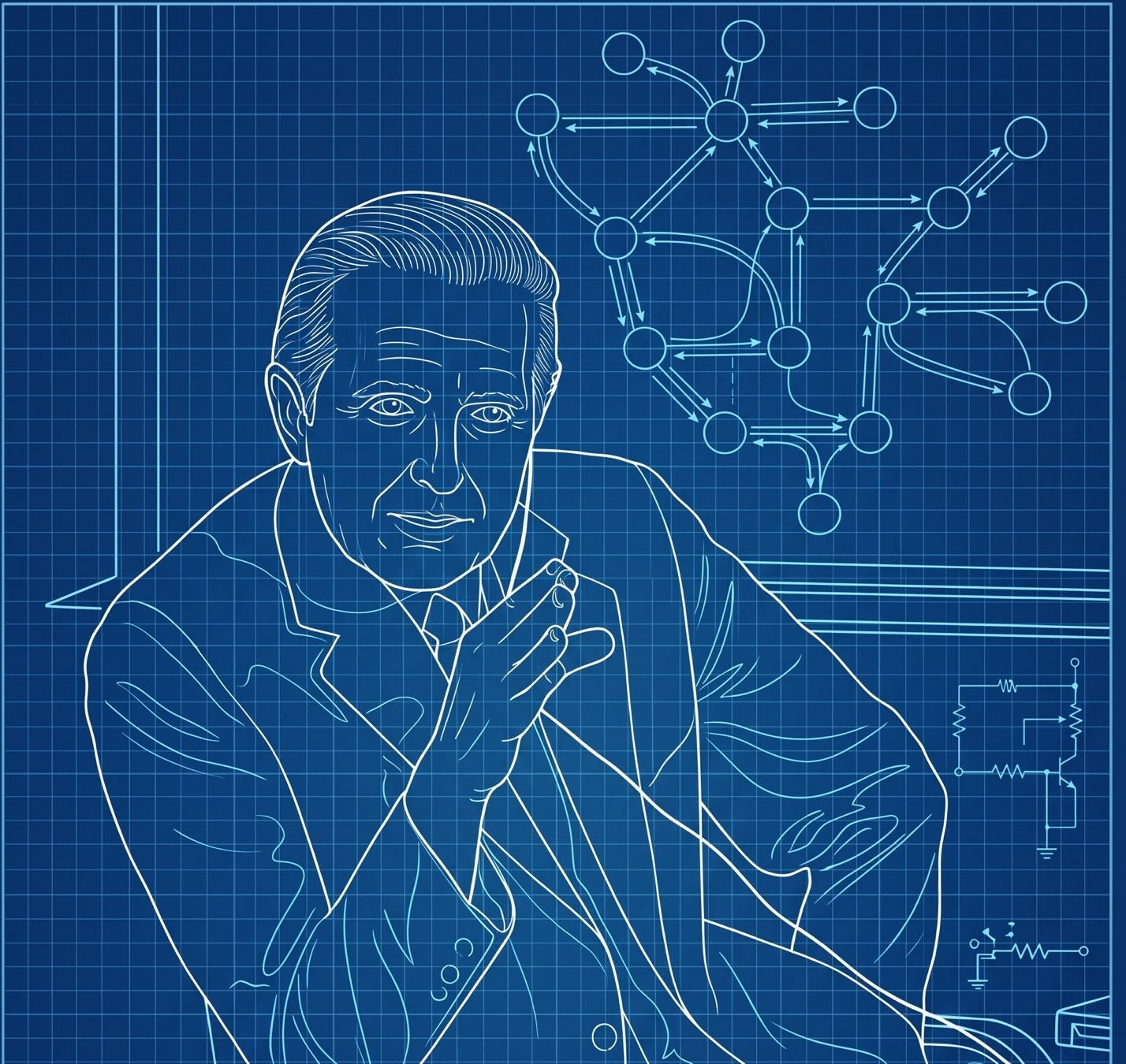
Douglas Engelbart from Wikimedia Commons Augmented by Gemini

“When people adopt powerful new tools, a subsequent co-evolution of the human systems is inevitable. Very seldom do you come in and just automate something and find that your change has had no other effect. The goal of augmenting rather than automating is being able to stimulate and design this co-evolution.” - Douglas Engelbart
“Although the flow experience appears to be effortless, it is far from being so... And yet while it lasts consciousness works smoothly, action follows action seamlessly. In normal life, we keep interrupting what we do with doubts and questions... But in flow there is no need to reflect, because the action carries us forward as if by magic” - Mihaly Csikszentmihaly
Stop thinking of AI as a “normal” technology. It’s unlike any technology we’ve ever built before because it separates us from our consciousness for the first time. Computers had our memory but lacked our ability to interpret that memory. For this, they still required human intervention. It was still a one-way street.
AI is different. It opens the possibility of a two-way street for ideas. It’s high time we started recognizing that. Before, machines made us stronger and faster, but they never made us smarter.
For that, we had to rely on far older technology like books. A digitized book is still a book. The only difference is that you can share it quicker. An AI library is a completely different experience because it trades in ideas, not volumes.
Ideas are what make us grow. AI can augment this ability, but we must stop treating it like the automation tools we’re used to building. We have to start thinking instead of just doing or we risk automating ourselves out of existence.
The Automation Default
Industrial thinking has conditioned us to be automators. That’s because the primary virtue of machines during the automation age was speed. Building things faster means you can build things cheaper. That’s because labor is the primary cost driver in any industrial process. The faster you build something, the less human time you have to buy.
This is a very hard mindset to shake. Even those who approach their work like it’s a craft are under constant time pressure. That’s because they run into the need to generate “product.” Artists struggle with this all the time. Commerce isn’t the reward, creation is. Ultimately, however, you need commerce to pay the bills.
Commerce forces us to get things done as quickly as possible. This is a problem whether something you value less is eating your time or because you’ve turned your craft into an industrial process. Life speeds up, leaving us little time for reflection.
Augmentation is about quality more than quantity. It’s about the quality of your life and deepening the quality of your work. This isn’t always faster, but it creates a richer human product.
We push augmentation aside for automation because automation makes us money more consistently than augmentation. We look to our machines to relieve time pressure so therefore, we naturally gravitate toward automation.
The Escape to Meaning
As I have watched people use AI, I have seen them instinctively grasp for its automation capacities. That’s because it seems to be the ultimate time saver.
Instead of doing your work, you can just ask the AI to do it for you. Students automate their writing by having the AI produce papers for them. Workers do the same.
The natural inclination among those who are required to assess that work is to try to deprive people of their shortcuts. This goes against every bone in their bodies.
If the work is meaningless, then it’s not unethical to do it in any way you can so that you can win back your time, the only finite resource there is. Most industrial behaviors like passing classes and getting out of the office early are an escape to meaning.
As a teacher, this has always been one of my greatest frustrations. Students who come into my class are trained that this is just a silly game to get credentialed.
As a manager, I found it easier to instill meaning in my employee’s work. However, the system always imposed requirements on the department that pushed a substantial percentage of my employees (and myself) into meaningless work.
The systems trained both my students and my employees that most of what they had to do lacked meaning. This was also a barrier.
Humans naturally rebel against this on an emotional level, but their reaction is often counterproductive. The key to finding good employees is finding people who value the human connection, especially in a service industry.
But that valuing always must transcend the extrinsic motivators like money or grades. We’ve been trained by the capitalist system that personal fulfillment is a luxury.
AI helps me find meaning. I know that sounds silly, but, by pushing all the dehumanizing tasks to the side, I can focus on the meaningful side of my job. My job isn’t to grade papers. It’s to expand minds.
Climbing the Cognitive Ladder
I do realize that automation makes augmentation possible. However, in the same way that I don’t want my students to be stuck at the lower ends of Bloom’s taxonomy, I don’t want to be stuck there either.
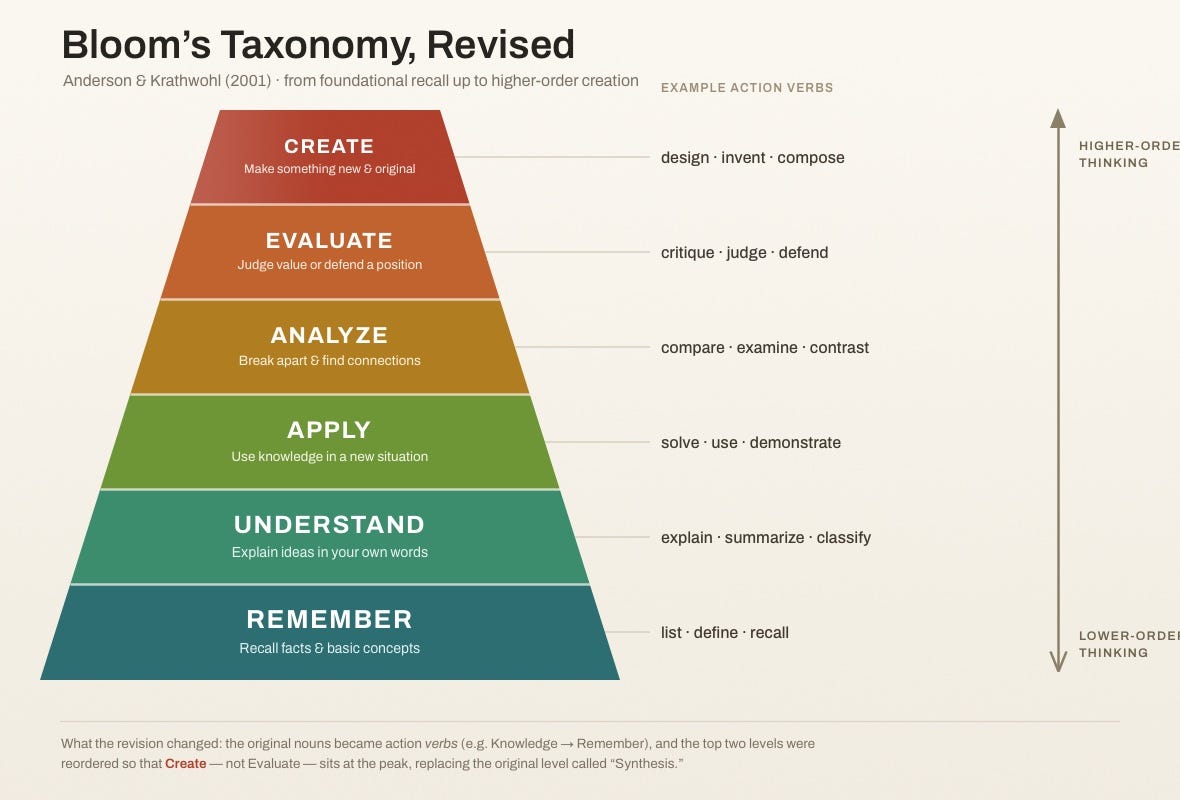
Image Generated by Claude from Krathwohl (2002)
AI lives at those levels. It can remember, understand, and apply ceaselessly and without complaint. If that’s all you do, you’re not augmenting, you’re automating. You only need those layers to create a slide deck, especially if it’s not a good one.
You only grow and learn if you are operating at the analyze, evaluate, and create layers. If AI can push you to those levels, it augments your ability to augment and learn. If you never let it push you that high, you are doomed to be replaced by it.
Partners, Servants, and the Flow State
I am constantly caught between two traps. On the one side, the system demands industrial behaviors, like watching the clock and completing the class from both my students and myself. On the other, my students are trained to value those industrial cues. Value is not the same thing as meaning.
However, this is not confined to education. When I see people talk about AI it’s always about accelerating industrial processes. It’s all about making that meaningless PowerPoint that much faster.
This may be true, but it misses the real opportunity with the human AI partnership. A partnership is a much more equal relationship than master and servants.
Partners expand your possibilities. Servants just serve your existing reality. An AI partner offers you new ideas built on your own. An AI servant saves you time. It doesn’t change your task structure.
With a servant, you’re still on your own when it comes to driving growth. With a partner, negotiating that growth is part of the process of growing. This is also why grades and money are not the same thing as meaning. You get meaning from working with others.
My most rewarding experiences using generative AI are when I can learn as much from the process as I do from the result. Sometimes this means engaging with other humans through their writing in a deep, interactive way using Notebook LM. Sometimes this means kicking ideas back-and-forth until the LLM (either Claude or Gemini in my case) suggests something that I’m not expecting.
This is a learning process. I do this with humans too, but humans have limited time (especially if they are hostage to commerce). The most rewarding flow experiences I have is when that time disappears because I’m totally engaged in the conversation.
Now, I can have these conversations with my models. More than once recently, I’ve completely lost track of time as I discussed ideas with an AI model.
This is codesign happening in real time. I find myself in a flow state far more often these days. That means I’m growing my ideas as I debate with the large language model. It’s not smart but its ability to make connections is what makes it a powerful interlocutor.
Steven Johnson defined something similar as ‘cognitive uploading.’ His Substack argues that AI giving us more to think about and he’s right. But uploading is only half the street. The other half is whether the thinking changes you.
Augmentation requires that we go further. If you don’t grow from it, it’s automation not augmentation.
Partnership is a productive way of thinking this through.